If you’re searching “how much does a stair lift cost,” the most useful answer depends on your staircase and the person who’ll use the lift. Quotes can differ because a straight staircase has different installation needs from one with turns or landings. The resident’s mobility needs and the full project scope also affect the estimate.
This guide explains what to look for when comparing stair lift plans and how to prepare for a home assessment. You’ll learn which details can affect equipment fit and installation, and what questions to ask about the proposed scope. HomeSafe Living Solutions provides stair lift installation and accessibility planning for homeowners in Clackamas, Wilsonville, West Linn, Oregon City, and Tualatin.
Key Takeaways
- When estimating how much a stair lift costs, focus on your home’s layout and project scope rather than expecting one figure to fit every staircase.
- Compare options by staircase type, equipment fit, customization, and the installation work included, not just by equipment category.
- Prepare for an assessment by describing your stairs, sharing mobility goals, and noting access concerns.
- HomeSafe Living Solutions helps homeowners in Clackamas, Wilsonville, West Linn, Oregon City, and Tualatin plan a tailored stair lift installation.
What determines how much a stair lift costs for your home?
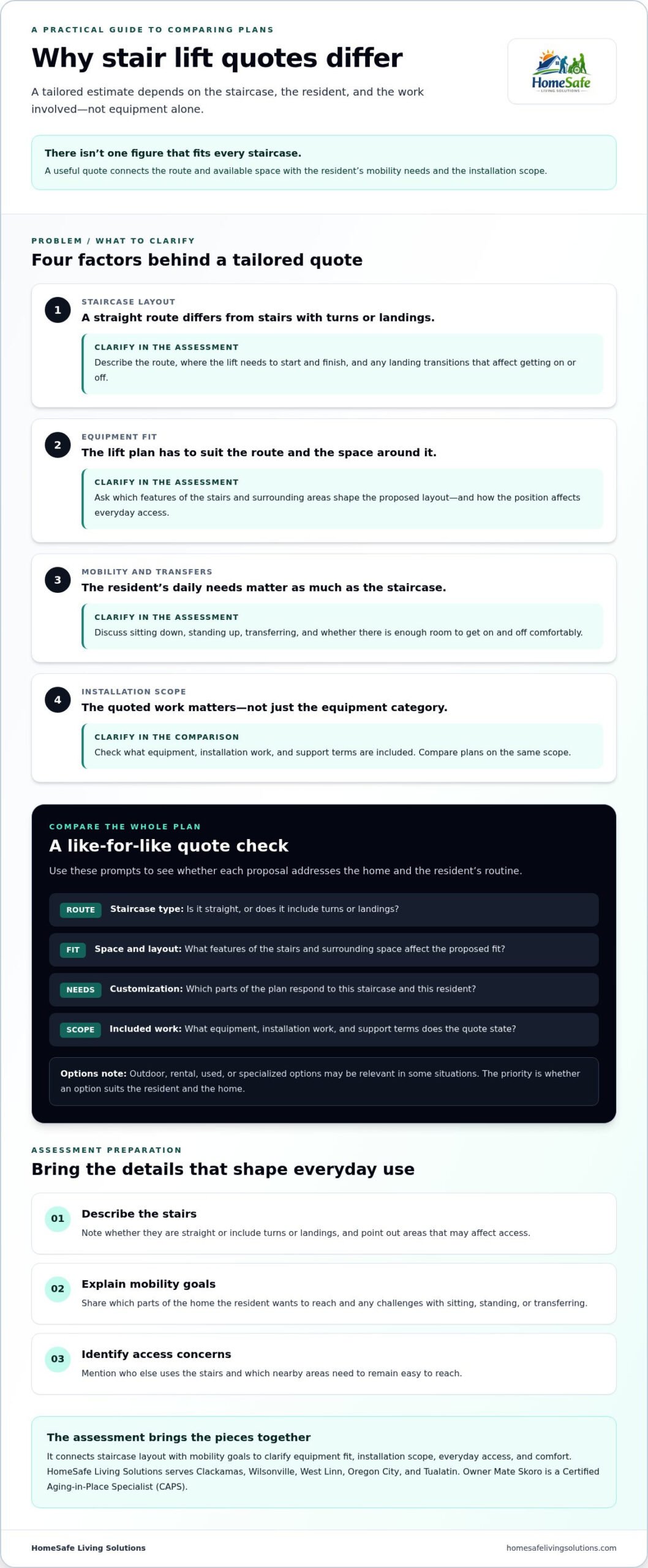
A stair lift quote is specific to the home and the person who’ll use it. There isn’t one figure that fits every staircase: the equipment must suit the route, the resident’s needs, and the installation work involved. A general overview of stair lift types and features is available in Stairlift, but an in-home assessment connects those options to your actual layout.
The main factors behind a tailored quote are staircase layout, equipment fit, mobility and transfer needs, and installation scope. Consider these together to understand the project more clearly than you would by comparing equipment alone.
How staircase layout and mobility needs shape the estimate
A straight staircase presents a different installation route from stairs with turns or landings. The route, available space, and where the lift needs to start and finish all affect equipment fit and the work involved. At a landing, consider how the resident will move between sections and whether there is enough room to get on and off comfortably.
The assessment should consider the person as well as the stairs. Can the resident sit down and stand up comfortably? Do they need room to transfer? Will the lift’s position leave convenient access to the stairs and nearby areas? These details help shape a plan around everyday use rather than assuming that one configuration suits everyone.
HomeSafe Living Solutions plans professional stair lift installations around the resident’s mobility, the staircase, and how they want to use their home. Owner Mate Skoro, a Certified Aging-in-Place Specialist, brings aging-in-place expertise to the assessment. Discussing the route and daily needs helps clarify the project scope and identify practical next steps.
How to compare stair lift options without overlooking project scope
A useful comparison looks beyond the lift category to how the entire project fits your home and routine. If you’re weighing how much does a stair lift cost, compare what each proposed plan includes, not just the equipment named in the quote.
Use these prompts to organize your notes:
- Staircase type: Is the route straight, or does it include turns or landings?
- Fit considerations: What features of the stairs and surrounding space affect the proposed layout?
- Customization: Which parts of the plan are tailored to your staircase and the resident’s needs?
- Assessment questions: How does the plan account for transfers, everyday access, and the lift’s intended use?
Compare the full proposed scope, including the equipment, installation work, and any support terms stated in the quote. Check that the plan addresses the staircase layout and the resident’s daily needs, and note what is included so you can make a like-for-like comparison. Outdoor, rental, used, or specialized options may be relevant in some situations, but the priority is whether an option suits the resident and the home.
Which stair lift considerations matter most before requesting a quote?
Start with the staircase layout, the resident’s day-to-day mobility, and how the lift will be used. Consider whether the resident can transfer comfortably, whether anyone else uses the stairs, and which parts of the home need to stay accessible. Sharing these details helps the assessment focus on the actual home and the resident’s routine.
HomeSafe Living Solutions assesses the staircase and mobility goals as part of professional stair lift installation planning. To discuss your home’s needs, arrange a home assessment.
Plan a stair lift assessment with a local accessibility team
Questions like “how much does a stair lift cost” are easier to address when an assessment considers both the staircase and the person who’ll use the lift. A little preparation can keep the conversation focused on daily comfort, access, and the project scope.
- Describe the stairs: Note whether they’re straight or include turns or landings, and point out any areas that may affect access.
- Discuss mobility goals: Explain which parts of the home the resident wants to reach and any challenges with sitting, standing, or transferring.
- Identify access concerns: Mention who else uses the stairs and which nearby spaces need to remain easy to reach.
HomeSafe Living Solutions serves homeowners in Clackamas, Wilsonville, West Linn, Oregon City, and Tualatin with stair lift installation and accessibility planning tailored to the home and resident.
What happens during a stair lift home assessment?
The assessment connects the staircase layout with the resident’s mobility and goals for using the home. It helps clarify equipment fit and installation scope, with attention to everyday access and comfort. Use the conversation to explain concerns that may not come across in a brief description, such as transfer needs or access to nearby areas.
Owner Mate Skoro is a Certified Aging-in-Place Specialist (CAPS), bringing relevant expertise to conversations about adapting a home as needs change. To plan a practical next step, request a home assessment.
Take the next step toward safer access at home
There’s no single answer to how much does a stair lift cost, because the right plan depends on the staircase, the resident’s mobility needs, and the installation scope. Comparing equipment fit and the work included can help you understand what a proposal covers and how it supports everyday access.
A home assessment brings those details together. HomeSafe Living Solutions provides professional stair lift installation and accessibility modifications, with planning shaped around the resident and their home. Owner Mate Skoro is a Certified Aging-in-Place Specialist (CAPS), bringing aging-in-place expertise to the conversation.
Request a home assessment and take the next step toward safer, more comfortable access. A plan tailored to your home can help you move forward with greater confidence, comfort, and independence.
Frequently Asked Questions
How much does a stair lift cost?
There isn’t one price that fits every home. How much does a stair lift cost depends on the staircase layout, equipment fit, the resident’s mobility needs, and the installation scope. A home assessment brings these factors together to shape a project-specific quote. HomeSafe Living Solutions provides stair lift installation for homeowners in Clackamas, Wilsonville, West Linn, Oregon City, and Tualatin.
Why do curved stair lifts usually cost more than straight stair lifts?
Curved stair lifts generally need a rail shaped to follow turns or landings, while a straight staircase has a simpler route. The staircase’s complexity and the work needed to fit equipment to that route affect the project scope. An assessment considers the actual layout and the resident’s needs to clarify which approach may suit the home.
What factors should I compare when reviewing a stair lift quote?
Compare the proposed equipment and fit, the installation work included, and any support terms stated in the quote. Check that the plan reflects the staircase layout, the resident’s mobility and transfer needs, and how the lift will be used each day. Reviewing the full project scope makes it easier to understand the differences between proposals.
Can a stair lift be installed on any staircase?
Not every staircase suits the same equipment or installation plan. Turns, landings, available space, and access at the top and bottom all matter, as do the user’s mobility and transfer needs. A professional home assessment evaluates these details and helps establish a project scope based on the actual home.