
What if the standard industrial height for a grab bar actually makes your personal bathroom less safe? It’s a common worry for families who want to protect their loved ones without turning a beautiful home into a clinical facility. We understand that you’re looking for more than just hardware; you’re looking for the peace of mind that comes with a secure, stable environment. This guide reveals the best placement for grab bars in shower by focusing on your unique movement patterns rather than just a one-size-fits-all rule.
You’ll discover the exact heights and angles needed to ensure maximum support, the critical differences between vertical and horizontal bars, and how professional installation protects your tile. We’ve designed this 2026 roadmap to help you create a safer home that honors your dignity and allows you to enjoy your independence for years to come.
Key Takeaways
- Learn to create a customized “movement map” that identifies the three critical zones of your bathroom, starting with high-risk entry and exit points.
- Discover why the best placement for grab bars in shower should be tailored to your specific height while adhering to the 33–36 inch safety standard.
- Understand why 24-inch and 36-inch bars are the preferred residential choice for providing maximum stability and a secure grip area.
- Protect your home with professional installation techniques like wall “blocking,” which ensures your bars can safely support 250 pounds or more.
Mapping Your Movement: The Three Critical Zones for Shower Grab Bars
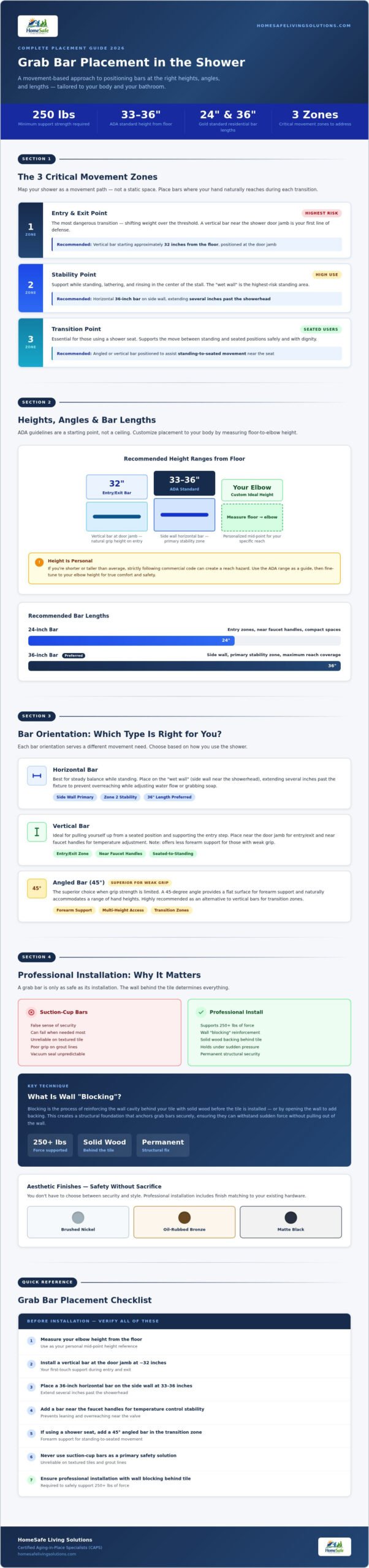
Most falls happen because we treat the shower as a static space. As a Certified Aging-in-Place Specialist (CAPS), Mate and his team view your bathroom as a “movement map.” This approach ensures the best placement for grab bars in shower by following your natural path of travel from the moment you reach for the curtain to the moment you step back onto the bath mat. By identifying how you actually move, we can place support exactly where your hand naturally reaches.
- Zone 1: The Entry and Exit Point. This is where the most dangerous transitions occur as you shift your weight over the threshold.
- Zone 2: The Stability Point. These bars provide steady support while you’re standing, lathering, or rinsing in the center of the stall.
- Zone 3: The Transition Point. Essential for those using a shower seat, these bars help you move from a standing to a seated position with dignity.
Entry Wall Placement: Ensuring a Confident Step
A vertical bar installed near the shower door jamb is your first line of defense. It’s often the most critical addition for maintaining balance during that initial, slippery step. For most homes, we recommend these bars start approximately 32 inches from the floor. This height allows you to maintain a natural grip as you transition into the space. By tailoring the best placement for grab bars in shower to your specific reach, we create a setup that feels like a natural part of your home rather than a medical addition. Peace of mind begins with knowing every step is supported.
Step-by-Step Guide to Grab Bar Heights, Angles, and Lengths
While ADA guidelines suggest a standard height of 33 to 36 inches, the best placement for grab bars in shower is always the one that fits your body. If you’re shorter or taller than average, sticking strictly to commercial code can actually create a reach hazard. We recommend measuring from the floor to the user’s elbow to find a comfortable mid-point. For most residential bathrooms, 24-inch and 36-inch bars are the gold standard. These lengths provide enough surface area to catch a slip without overwhelming the room’s aesthetic. We often suggest a 36-inch bar for the side wall to ensure there’s always a handhold within reach.
The Side Wall Strategy: Horizontal Support for Balance
The “wet wall” is where you spend the most time standing and rinsing. A long horizontal bar here should always extend several inches past the shower head. This clever positioning prevents you from overreaching while adjusting the water flow or grabbing soap. If you’re planning an aging-in-place home modification, this continuous line of support is vital for maintaining steady footing on slippery, soapy surfaces. It transforms a high-risk area into a secure sanctuary.
Vertical vs. Angled Bars: Which is Right for You?
Vertical bars are perfect for pulling yourself up from a seated position, but they don’t offer much help if you struggle with grip strength. In those cases, a 45-degree angled bar is often the superior choice. It provides a flat surface for forearm support and accommodates various hand heights naturally. Placing a smaller vertical bar specifically near the faucet handles ensures you’re stable while adjusting the temperature. This tailored approach ensures your bathroom remains a place of comfort and dignity.
Professional Integration: Why Secure Installation Matters in Oregon Homes
Many homeowners are tempted by the convenience of suction-cup grab bars, but these often provide a false sense of security. They can fail when you need them most, especially on textured tile or grout lines where the vacuum seal can’t hold. For true peace of mind, professional installation is the only way to ensure your bars can support 250 pounds or more. This level of safety requires “blocking,” a process where we reinforce the wall behind your tile with solid wood. This structural foundation ensures your safety hardware stays exactly where it belongs, even under sudden pressure.
Beyond strength, we focus on the intersection of aesthetics and utility. You don’t have to sacrifice your bathroom’s character for security. We carefully select finishes like brushed nickel, oil-rubbed bronze, or matte black that blend beautifully into your existing fixtures. Even the best placement for grab bars in shower won’t feel right if it looks like a hospital room. Our goal is to make these life-improving modifications feel like a tailored part of your home’s original design, preserving both your style and your dignity.
The HomeSafe Difference: Expert Accessibility in Eugene
Mate and his team bring a specialized perspective as Certified Aging-in-Place Specialists (CAPS). We don’t just bolt bars to a wall; we evaluate your specific mobility needs to find the best placement for grab bars in shower based on your daily routine. We’re proud to serve neighbors throughout Clackamas, Wilsonville, and West Linn with professional ADA remodels that restore independence. Every home is unique, and we treat your project with personal honor and craftsmanship. Schedule your Free Home Assessment with Mate and the team today to start your journey toward long-term comfort and security.
Secure Your Independence and Peace of Mind Today
Creating a safe bathroom isn’t about following a rigid set of commercial rules; it’s about honoring your unique needs and the character of your home. By focusing on a personalized movement map and choosing the best placement for grab bars in shower, you’re investing in your long-term independence. You’ve seen how customized heights, strategic angles, and professional wall blocking create a foundation of safety that supports over 250 pounds without sacrificing style.
Mate and his team at HomeSafe Living Solutions bring the expertise of a Certified Aging-in-Place Specialist (CAPS) to every project in Eugene and Clackamas. We’re here to ensure your bathroom remodel provides the security your family deserves. Get Peace of Mind with a Free Home Accessibility Assessment and take the first step toward a safer, more comfortable home today.
Frequently Asked Questions
What is the standard height for a shower grab bar in a residential home?
The standard height for a residential grab bar typically follows ADA guidelines of 33 to 36 inches from the floor. However, the best placement for grab bars in shower depends on the user’s specific height and reach. We often adjust these measurements during a home assessment to ensure the bar sits at a natural grasping level for the person using it most.
Can grab bars be installed over existing tile without breaking it?
Yes, professional installers can securely mount grab bars over existing tile without causing cracks or damage. We use specialized diamond-tipped drill bits and precision techniques to penetrate the tile and reach the structural blocking behind it. This ensures a stable, 250-pound weight capacity while maintaining the integrity and beauty of your current bathroom surfaces.
Are vertical or horizontal grab bars better for shower safety?
Both serve essential but different safety functions. Horizontal bars are ideal for maintaining balance while standing or rinsing, whereas vertical bars provide a stable “pull up” point for stepping over a threshold. Often, the best placement for grab bars in shower involves a combination of both to support every stage of your movement throughout the bathing process.
How many grab bars do I actually need for a safe walk-in shower?
Most safe walk-in showers require at least three grab bars to provide complete coverage. We typically recommend one vertical bar at the entry, one long horizontal bar on the side wall, and a third bar near the faucet or shower seat. This configuration ensures there’s always a secure handhold available, regardless of where you’re standing or sitting in the stall.