

If you’re asking, “does Medicare cover stair lifts in Oregon,” the short answer is no for Original Medicare. That can feel discouraging when stairs make it harder to move around your home and equipment costs are a concern.
There may be other paths to explore. Some Oregon Medicare Advantage plans offer home safety benefits, and the Oregon Health Plan’s K Plan may cover a stair lift for eligible members when it is approved as medically necessary. This guide explains the difference between Medicare Part B and Part C, what to ask your plan, and how Oregon funding options work. It also explains why Medicare coverage for home safety evaluations in 2026 does not include stair lift installation, and how a HomeSafe Living Solutions Free Home Assessment can help identify safety needs and potential funding paths.
Key Takeaways
- Wondering “does Medicare cover stair lifts in Oregon”? Learn why Original Medicare generally excludes them and what that may mean for your budget.
- Find out what to ask your Medicare Advantage plan, since home safety benefits and stair lift coverage can vary.
- Explore whether Oregon Health Plan’s K Plan may be a funding path if you meet eligibility requirements and receive approval.
- Understand why professional installation matters for safety, and how a HomeSafe Living Solutions Free Home Assessment can help identify your needs and possible funding paths.
Does Medicare Cover Stair Lifts in Oregon? Original Medicare Rules
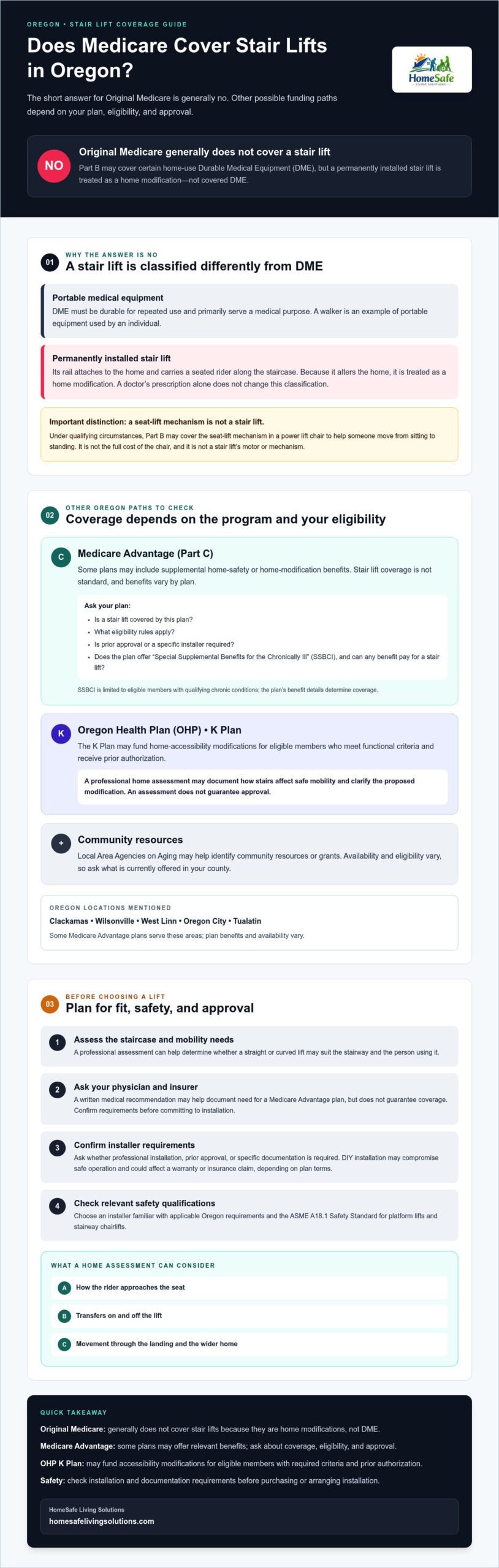
Does Medicare cover stair lifts in Oregon? Original Medicare, including Part B, generally does not. Part B can cover certain Durable Medical Equipment (DME) prescribed for home use, but a stair lift is treated as a home modification, not covered DME. The distinction can be frustrating: needing to reach another floor may be a real concern, even when Medicare’s equipment rules do not classify a permanently installed lift as eligible.
Stair Lifts vs. Durable Medical Equipment (DME)
DME must be durable enough for repeated use and primarily serve a medical purpose. A walker, for example, is portable equipment used by an individual. A stair lift’s rail is attached to the home and carries a seated rider along a staircase. That permanent installation affects how Medicare classifies it. Although a stair lift supports mobility, it alters the home rather than functioning as portable medical equipment. A doctor’s prescription alone does not change that classification.
A similarly named benefit can cause confusion. Under qualifying circumstances, Part B may cover the seat-lift mechanism in a power lift chair when medical and coverage requirements are met. That mechanism helps someone move from sitting to standing. It is not the full cost of the chair, and it is not the motor or mechanism of a stair lift.
For Oregon residents hoping to age in place, this coverage gap can raise concerns about independence and managing stairs safely. A “no” from Original Medicare does not mean every funding option is closed. Check whether other programs or insurance benefits may apply, and distinguish the equipment’s medical need from Medicare’s specific DME rules.
Oregon Funding: Medicare Advantage and OHP
If you’re asking, “does Medicare cover stair lifts in Oregon,” Original Medicare is not the only place to check. Some Medicare Advantage (Part C) plans serving Clackamas, Wilsonville, West Linn, Oregon City, and Tualatin may include supplemental home safety or home modification benefits, but stair lift coverage is not standard. Call the number on your plan card and ask whether a stair lift is covered, what eligibility rules apply, and whether prior approval or a specific installer is required.
Medicare Advantage vs. Oregon Medicaid (OHP)
Ask your plan specifically about “Special Supplemental Benefits for the Chronically Ill” (SSBCI) and whether any benefit can pay for a stair lift. SSBCI is limited to eligible members with qualifying chronic conditions, and the plan’s benefit details determine what it covers. OHP has different eligibility rules. The K Plan is an Oregon Medicaid program that may fund home accessibility modifications for eligible members who meet functional criteria and receive prior authorization.
A professional home assessment can document how stairs affect safe mobility and help clarify the proposed modification before you contact a plan or apply for state support. An assessment does not guarantee approval. For an Oregon-specific reference, consult the Oregon Durable Medical Equipment Resource Guide, then ask OHP or your case manager about current requirements and authorization steps.
Local Area Agencies on Aging can also help you look for community resources or grants. Availability and eligibility vary, so ask what is currently offered in your county. If you live in Clackamas, Wilsonville, West Linn, Oregon City, or Tualatin, a Free Home Assessment for stair lift planning can help identify safety needs and potential funding paths before you decide.
Professional Stair Lift Installation in Oregon: Beyond the Cost
A stair lift needs to fit both the staircase and the person using it. DIY installation may compromise safe operation and could affect a warranty or insurance claim, depending on the plan’s terms. Before purchasing, ask your insurer whether it requires professional installation, prior approval, or specific documentation. For safety, choose an installer familiar with applicable Oregon requirements and the ASME A18.1 Safety Standard.
HomeSafe Living Solutions provides stair lift installations and aging-in-place modifications. Mate Skoro, the company’s owner and operator, is a Certified Aging-in-Place Specialist (CAPS). During a home assessment, the specialist can consider more than the staircase itself, including how the rider approaches the seat, transfers on and off, and moves through the landing. This helps clarify the home’s mobility needs before choosing a solution.
Steps to Securing a Stair Lift in Your Oregon Home
- Assess the staircase. Arrange a professional home assessment to determine whether a straight or curved lift may suit the stairway and the person’s mobility needs.
- Ask your physician and insurer. A written medical recommendation may help document need for a Medicare Advantage plan, but it does not guarantee coverage. Confirm the plan’s requirements before committing to installation.
- Check installer qualifications. Ask about relevant Oregon building requirements, permits, and safe installation practices. Do not assume an installer or project meets ADA requirements without checking what applies to your home.
If you’re still weighing does Medicare cover stair lifts in Oregon against other funding routes, an assessment can help clarify safety needs and potential next steps without promising insurance approval. For more ideas on planning home changes, read the Aging in Place Home Modification Guide.
Make Your Oregon Home Safer and More Accessible
If you’re still asking “does Medicare cover stair lifts in Oregon,” remember that Original Medicare generally does not, but some Medicare Advantage plans and Oregon Health Plan programs may offer funding paths for eligible people. Check your plan’s rules and any approval requirements before making a decision. A stair lift may be one way to support movement around your home.
HomeSafe Living Solutions serves Clackamas, Wilsonville, West Linn, Oregon City, and Tualatin with ADA remodels, aging-in-place modifications, and stair lift installations. An assessment can help clarify your needs and potential funding options. Because coverage depends on your plan and eligibility, confirm approvals directly with the relevant insurer or program.
Frequently Asked Questions
Does Medicare Part B cover stair lifts in Oregon?
No. If you’re asking “does Medicare cover stair lifts in Oregon,” Original Medicare Part B does not pay for the stair lift itself. Starting in 2026, Medicare may cover certain home safety evaluations, but that benefit does not include installing equipment such as a stair lift. If you have Medicare Advantage, review your plan documents and confirm any coverage and approval requirements directly with the insurer.
Will the Oregon Health Plan (Medicaid) pay for a stair lift?
It may for eligible Oregon Health Plan members. The K Plan can support home modifications when a person meets functional eligibility criteria and the lift is deemed medically necessary with prior authorization. Ask your OHP case manager about current application steps and required documentation before arranging work. Eligibility and approval depend on your circumstances, so do not assume funding until it is confirmed.
Are stair lifts tax-deductible as a medical expense in Oregon?
A stair lift prescribed for a medical condition may count as a federal medical expense under IRS Publication 502. Generally, you can deduct only qualifying unreimbursed medical expenses that exceed 7.5% of your adjusted gross income, subject to tax rules. Keep the prescription and receipts, and ask a tax professional how the expense applies to your federal return and Oregon tax situation.
How much does a stair lift cost in Clackamas County and nearby areas without insurance?
The price depends on the staircase and lift configuration. A straight staircase differs from one with curves, which may require a custom solution. For a home in Clackamas, Wilsonville, West Linn, Oregon City, or Tualatin, request an in-home assessment and a written estimate. Ask what equipment and installation are included, and whether the quote accounts for the staircase’s specific layout.
To discuss stair lift planning and accessibility needs in Clackamas, Wilsonville, West Linn, Oregon City, or Tualatin, schedule a Free Home Accessibility Assessment with HomeSafe Living Solutions.