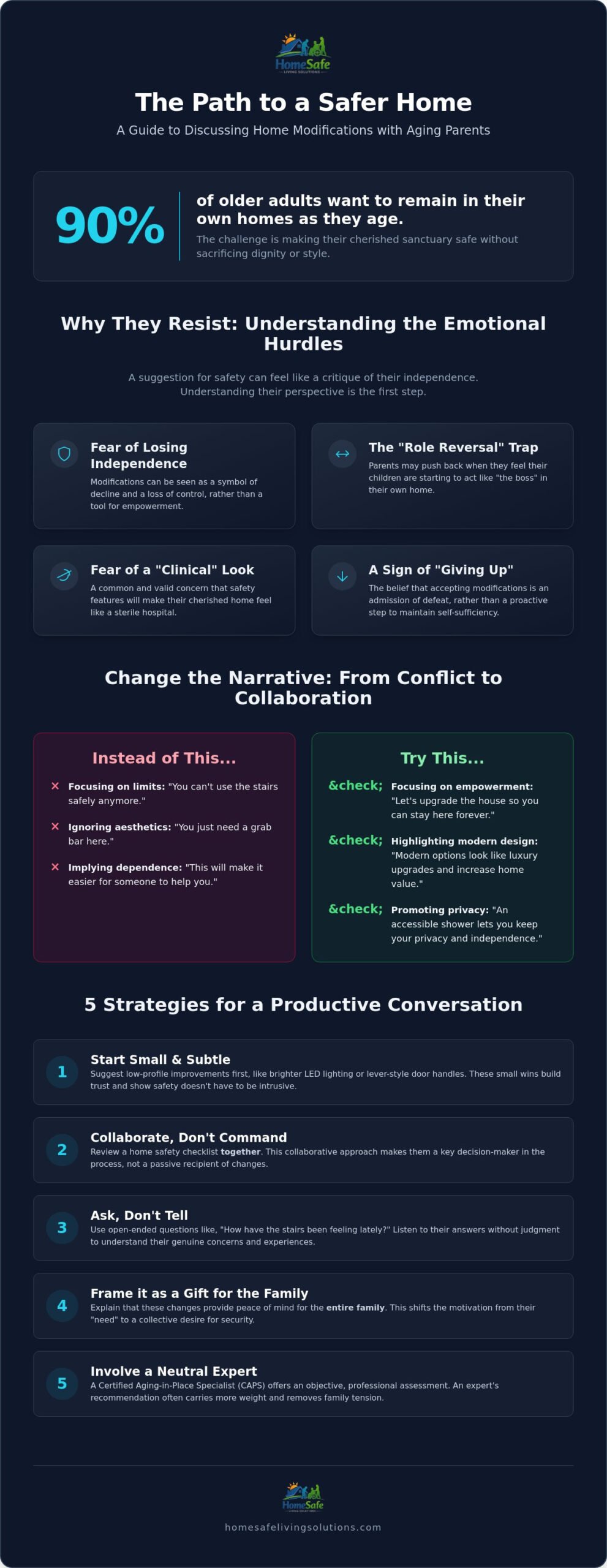
Imagine standing in the kitchen where you grew up, watching your mother hesitate at the single step leading to the dining room. You want to reach out, but you know that suggesting a stair lift or a handicap accessible bathroom might be met with a sharp “I’m not an invalid.” Learning how to convince parents to accept home modifications is rarely about the construction itself; it’s about navigating the deep emotional waters of aging and independence. You aren’t alone in this struggle. With over 90% of older adults preferring to stay in their own homes according to recent data, the challenge is making that sanctuary safe without making it feel like a hospital.
We understand the heavy guilt that comes with pushing for change and the heart-stopping fear that follows every unexpected noise from the next room. You want them to be safe, yet you don’t want to strip away their sense of control. This guide will show you how to transform these difficult talks into collaborative planning sessions that preserve your parents’ dignity. You’ll learn how to frame aging in place home modifications as strategic upgrades that protect their legacy. We’ll cover how to choose designs that blend into the home’s character and how professional assessments can provide the reassurance your family needs.
Key Takeaways
- Understand the emotional psychology behind resistance and how to reframe safety features as tools that empower independence rather than signal decline.
- Discover the most effective ways of how to convince parents to accept home modifications by asking open-ended questions that value their input and autonomy.
- Learn why starting with subtle, low-profile changes can help build trust and ease the transition toward more significant accessibility improvements.
- Explore how modern wheelchair-accessible showers and stair lifts can blend beautifully into your home’s aesthetic, maintaining both style and security.
- Gain the confidence to lead a conflict-free conversation that results in a safer home environment and lasting peace of mind for the whole family.
Why Seniors Resist Home Modifications (and How to Reframe the Conversation)
Understanding the deep-seated psychology behind resistance is the first step in learning how to convince parents to accept home modifications. For many seniors, their home is more than just a building; it’s a sanctuary where they’ve spent decades as the primary decision-makers. When you suggest installing a grab bar or a stair lift, they don’t see a helpful safety feature. Instead, they see a symbol of decline and a loss of the person they used to be. This often leads to the “Role Reversal” trap, where parents push back simply because they feel their children are starting to act like “the boss.”
To move past this, you must change the narrative. Instead of focusing on their physical limits, frame the conversation around the concept of aging in place. The goal isn’t to change them, but to upgrade their environment so they can stay in the house they love forever. Sometimes, it helps to wait for a “teachable moment.” If they experience a minor slip or mention that the stairs are feeling steeper lately, use that as a gentle entry point. Ask them how they feel about the situation rather than telling them what they need to do.
The Fear of the ‘Clinical’ Look
The most common objection families face is the fear that a handicap bathroom remodel will make the home look like a nursing facility. This is a valid concern, but modern aging in place home modifications have come a long way. By utilizing Universal Design, we can install features that look like high-end, luxury upgrades. High-quality finishes and thoughtful craftsmanship ensure that safety doesn’t come at the cost of your home’s character or beauty.
Independence vs. Assistance
Many seniors worry that modifications mean they’re giving up. In reality, the opposite is true. A wheelchair accessible shower or a walk-in tub actually reduces the need for a caregiver’s help, allowing your parents to maintain their privacy and dignity. We’ve seen firsthand how independence is maintained through smart environmental design in the Portland area. When the home is tailored to their current needs, they can continue to live life on their own terms without constant intervention.
5 Strategies for a Productive Conversation About Aging-in-Place
Starting small is often the most effective way to begin. Instead of leading with a massive renovation, suggest low-profile improvements like brighter LED lighting or sleek lever-style door handles. These small wins build trust and show that safety doesn’t have to be intrusive. You can even walk through a home safety checklist together to identify simple fixes that make immediate life easier. This collaborative approach is vital when figuring out how to convince parents to accept home modifications without making them feel defensive or overwhelmed.
Shift your language from commands to curiosity. Ask open-ended questions like, “How do you feel about the stairs lately?” or “Would it be easier if the bathroom floor wasn’t so slippery?” Listen to their answers without judgment. Often, parents are more willing to accept a change if they know it provides peace of mind for their children. Framing a project as a gift of security for the whole family can be a powerful motivator that bypasses the typical “role reversal” friction.
The Advantage of a Certified Aging-in-Place Specialist (CAPS)
Sometimes, the best strategy is to step back and let a professional take the lead. A Certified Aging-in-Place Specialist (CAPS) is trained specifically to balance clinical safety needs with home aesthetics. For Portland homeowners, hiring a CAPS-designated professional removes the personal tension from the decision. When considering how to convince parents to accept home modifications, having an expert opinion often carries more weight than a family member’s suggestion. The expert becomes a neutral third party who provides objective recommendations based on professional standards.
Focusing on Long-Term Home Value
If your parents are concerned about the cost or the “look” of the project, discuss the investment as “future-proofing.” In local real estate markets like Gresham and Damascus, a handicap bathroom remodel is no longer seen as a niche modification. It’s a high-value feature for multi-generational buyers and families looking for long-term stability. By choosing an ADA remodel that prioritizes craftsmanship and quality materials, you’re protecting their home’s legacy while ensuring their daily comfort.
Presenting the Solutions: Modifications That Blend Beautifully
Handicap Bathroom Remodels That Don’t Look ‘Handicap’
A modern handicap bathroom remodel can actually increase the luxury feel of a home. By using high-end tiling and sleek glass panels, we create curbless, wheel chair accessible showers that resemble high-end spa features. These designs eliminate tripping hazards while looking intentional and sophisticated. In Clackamas homes, professional craftsmanship ensures ADA compliance without sacrificing style, allowing your parents to enjoy a space that is both safe and stunning. To see how these sophisticated design concepts can be realized, check out Lux Renovations LLC.
Mobility Solutions Beyond the Bathroom
Freedom of movement shouldn’t stop at the bathroom door. For homes with multiple levels, a stair lift installation provides a smooth, quiet way to access the entire house without pain or risk. Modern lifts are compact and unobtrusive, folding away when not in use to keep hallways clear. Our team understands the specific challenges of Pacific NW architecture, including the common split-level homes found throughout Oregon. Whether it’s a custom entry ramp or a tailored lift, these tools are about restoring total home freedom.
The journey toward a safer home is a collaborative process that respects your parents’ history and their future. If you’re ready to show them what’s possible, the next step is a simple one. Scheduling a Free Home Assessment allows everyone to visualize the solutions in their own space. It’s a low-pressure way to see how we can protect their independence and provide the security they deserve. Peace of mind begins here.
Take the First Step Toward a Safer Home
Protecting your parents’ independence is one of the greatest gifts you can give. By reframing safety as a way to stay home forever and choosing designs that honor the house’s character, you move from conflict to collaboration. You’ve learned that understanding the psychology of aging and utilizing professional guidance are the keys to how to convince parents to accept home modifications. It isn’t about taking away their control; it’s about providing the stability they need to enjoy every room of their sanctuary for years to come.
Mate Skoro and his team bring local expertise to families in Portland, Gresham, and the surrounding areas. As a Certified Aging-in-Place Specialist (CAPS), Mate specializes in craftsmanship that blends ADA compliance seamlessly into your home’s existing aesthetic. We’re here to help you turn a stressful conversation into a clear, manageable plan. Peace of mind begins here.
Schedule a Free Peace-of-Mind Home Assessment with Mate and the Team to start visualizing a safer, more comfortable future for your family. You don’t have to navigate this transition alone.
Frequently Asked Questions
What is the best way to start a conversation about home safety with a stubborn parent?
The most effective approach is to lead with curiosity and ask open-ended questions about their daily comfort rather than pointing out their physical limits. Framing the discussion around your own “peace of mind” often helps because parents are usually more willing to make changes for their children’s sake than their own. This gentle, collaborative strategy is essential when learning how to convince parents to accept home modifications without triggering defensive feelings or a power struggle.
How can we make a home wheelchair accessible without it looking like a hospital?
You can achieve full accessibility by using Universal Design principles that prioritize both beauty and function. High-end materials like textured tiling, sleek glass for curbless showers, and modern lighting ensure that safety features blend seamlessly into your home’s existing character. Professional craftsmanship allows these modifications to feel like luxury upgrades rather than medical necessities, keeping the sanctuary of the home intact.
Does insurance or Medicare cover the cost of aging-in-place home modifications?
Traditional Medicare rarely covers home modifications because they are typically categorized as home improvements rather than durable medical equipment. However, other resources may be available. For fiscal year 2026, the VA Specially Adapted Housing grant offers up to $126,526 for eligible veterans, and the USDA Section 504 program provides grants up to $10,000 for very-low-income seniors aged 62 or older. It’s also helpful to check if your project qualifies for an IRS medical expense deduction.
What is a Certified Aging-in-Place Specialist and how can they help our family?
A Certified Aging-in-Place Specialist (CAPS) is a professional with specific training in the technical, business, and clinical aspects of home accessibility. They help your family by providing an objective, third-party assessment that removes the emotional tension between parents and children. By focusing on long-term comfort and ADA compliance, a CAPS ensures that every modification is tailored to your parents’ specific needs while maintaining the home’s value.
Are there local contractors in the Portland area who specialize in ADA remodeling?
HomeSafe Living Solutions is a locally owned business serving Portland, Gresham, and the surrounding communities. Led by Mate Skoro, our team focuses on high-quality ADA remodeling that respects the unique architectural styles of the Pacific Northwest. We help families navigate the process of how to convince parents to accept home modifications by offering professional assessments and “blended” designs that prioritize both security and home aesthetics.