Could your staircase be the only thing standing between you and the home you’ve lived in for decades? For many Oregon homeowners, the fear of a mechanical failure or a lift that’s too difficult to operate with arthritic hands creates real anxiety. We agree that your home should be a sanctuary of security, not a source of worry. Understanding the essential stair lift safety features is the first step toward reclaiming your independence with total confidence.
This guide details the safety standards required by the 2024 Oregon Elevator Specialty Code and the ASME A18.1 regulations. You’ll learn which fail-safe mechanisms protect you during local power fluctuations and how Mate and his team install systems that blend beautifully into your home’s aesthetic. Peace of mind begins here, with a look at how professional craftsmanship provides the lasting security your family deserves.
Key Takeaways
- Discover why swivel seat interlocks and retractable belts are critical for those with limited dexterity, ensuring the lift only moves when you are fully secured.
- Learn how integrated battery backup systems keep you moving safely during local power fluctuations, providing uninterrupted access to your entire home.
- Identify the essential stair lift safety features that must be professionally calibrated to prevent structural instability and ensure compliance with Oregon’s latest elevator codes.
- Understand the difference a CAPS-certified installation makes in blending safety equipment seamlessly into your home’s existing decor without sacrificing reliability.
Mechanical Stair Lift Safety Features: Ensuring Stability and Security
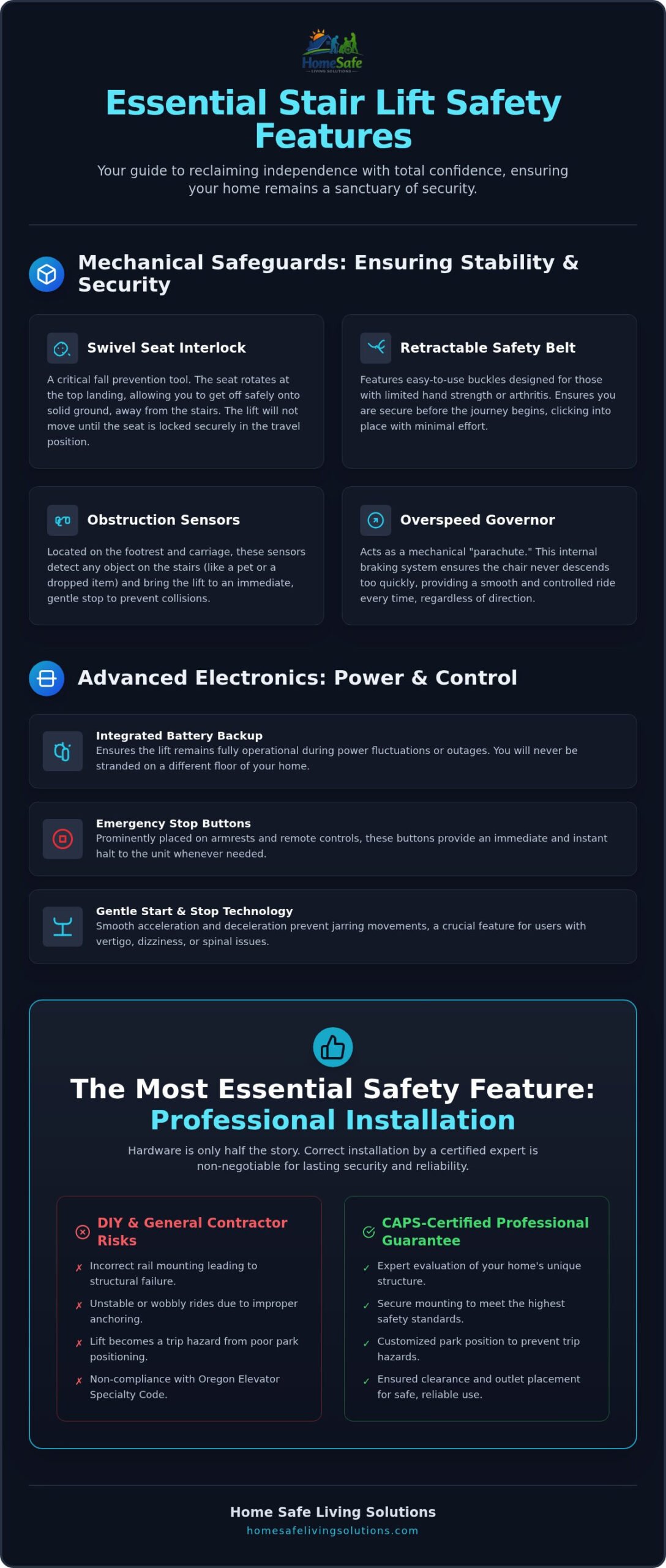
When you choose to stay in your multi-level home, stability is your greatest ally. High-quality systems include several essential stair lift safety features designed to prevent accidents before they happen. One often overlooked hero is the retractable safety belt. These aren’t like old car belts; they’re designed with easy-to-use buckles that click into place with minimal effort, which is a blessing for those managing arthritis or limited hand strength.
Safety extends to the very bottom of the unit. Modern footrest sensors detect obstructions like a stray shoe or a curious pet, bringing the lift to an immediate, gentle stop. To understand the underlying Stair Lift Mechanics and Safety, it’s helpful to know that these systems also include an overspeed governor, which acts as a mechanical parachute to ensure the chair never descends too quickly.
Why the Manual or Power Swivel Seat is a Critical Fall Prevention Tool
The moment you reach the top of the stairs is when you’re most vulnerable. A swivel seat allows you to turn the chair toward the landing, so you can stand up on solid ground while facing away from the staircase. This simple rotation eliminates the risk of a backward fall down the steps. While some prefer a manual swivel, a power swivel option is often better for those with limited upper-body strength. Integrating these tools into your broader Aging in Place Home Modification strategy ensures your home remains a sanctuary. Mate and his team focus on these interlocks because they prevent the motor from starting until the seat is safely locked back into the travel position.
Advanced Sensors and Power Backups for Essential Stair Lift Safety
Living in Clackamas County means preparing for winter storms and occasional power fluctuations. A battery backup system is one of the most essential stair lift safety features because it ensures you remain fully operational even when the grid goes down. A battery-powered lift ensures you are never stranded on a different floor during an unexpected blackout. To keep things running smoothly, modern lifts include diagnostic displays. These simple digital codes allow homeowners or Mate and his team to quickly identify if a safety gate is left open or if a sensor is simply blocked by a household item.
Control is a fundamental part of security. Every lift should feature prominent, easy-to-reach emergency stop buttons on both the armrest and the remote call stations. If you ever need to halt the unit instantly, these kill switches provide an immediate response. If you’re concerned about your current setup, a Free Home Assessment can help verify your system’s reliability and placement.
Obstruction Sensors and Safety Edges: Protecting Your Family and Pets
Safety edges located on the carriage and footrest react to even slight pressure. This prevents the lift from pinching a hand or colliding with an object left on the stairs. In the narrow, steep stairwells common in historic Oregon City homes, these sensors are vital for navigating tight spaces without incident. We also prioritize gentle start and stop technology. This smooth acceleration isn’t just about luxury; it’s a safety necessity for users dealing with vertigo or spinal issues. It prevents the jarring movements that can cause dizziness or physical discomfort during transit.
Why Professional Installation is the Most Essential Safety Feature
The hardware is only half the story. Even the most advanced essential stair lift safety features won’t protect you if the rail isn’t mounted correctly. In the older homes of West Linn or Tualatin, wall structures and stair treads require expert handling to prevent structural failure. A DIY attempt often leads to unstable rides or, worse, a rail that pulls away under pressure. Mate and his team ensure every bolt is secured to meet the highest safety standards, giving you the security you deserve.
Mate Skoro, a Certified Aging-in-Place Specialist (CAPS), looks beyond the staircase. He evaluates your entire mobility path to ensure these essential stair lift safety features work for your specific physical needs. This professional Stair Lift Installation process includes customizing the “park position.” By ensuring the lift folds away tightly at the top or bottom, we prevent it from becoming a trip hazard for other family members. It’s these small, tailored adjustments that make the difference between a clinical modification and a true home improvement.
The Importance of a Local, Professional Home Safety Assessment
During a Free Home Assessment, Mate and his team look for details a general contractor might miss. We check outlet placement for reliable charging and ensure there’s enough landing clearance for a safe exit. Our Compassionate Expert approach means we don’t just bolt on equipment; we ensure your modifications blend beautifully into your home’s character. Peace of mind begins here, with a plan tailored specifically to your daily routine. Transitioning from a safety consultation to a tailored independence plan is the most reliable way to restore your confidence. It’s about more than a chair; it’s about making your home a sanctuary once again.
Secure Your Future with a Safer Home
Reclaiming your independence starts with understanding the essential stair lift safety features that protect your daily life. We’ve explored how mechanical interlocks prevent accidents and how battery backups keep you moving during Clackamas power outages. Most importantly, professional installation ensures these systems are stable and reliable for years to come. Since 2021, Mate and his team have served families across Clackamas County and nearby communities with a focus on craftsmanship that blends beautifully into your home’s character.
As a Certified Aging-in-Place Specialist (CAPS), Mate provides the local expertise needed to transform your staircase into a safe pathway. Peace of mind begins here, and you don’t have to navigate these choices alone. Schedule Your Free Home Safety Assessment with Mate and his Team to start your journey toward a more secure home. Your comfort and dignity are worth the investment.
Frequently Asked Questions
What happens to my stair lift if there is a power outage in Clackamas?
Your stair lift will continue to operate normally because it runs on a battery that constantly recharges when the unit is parked. During a Clackamas power outage, the battery provides enough energy for several trips up and down the stairs. This ensures you are never stranded between floors. Mate and his team prioritize these battery systems to provide uninterrupted peace of mind.
Are stair lifts safe for people with dementia or cognitive impairments?
Stair lifts can be safe, but they often require a key-switch feature to prevent unsupervised use by those with cognitive impairments. This allows a caregiver in Wilsonville or West Linn to control when the lift is active. It’s vital to ensure the user has constant assistance during every trip. We evaluate these specific needs during our comprehensive home safety assessments.
How do obstruction sensors work if a pet is on the stairs?
Obstruction sensors are essential stair lift safety features that use sensitive safety edges on the footrest and carriage. If your pet is resting on a step, the lift detects the slight pressure and comes to an immediate, gentle stop. It won’t restart until the path is clear. This protective technology prevents injuries to your pets and protects the lift’s mechanical components.
What is the weight capacity for a standard safe stair lift installation?
A standard safe stair lift installation typically supports a weight capacity between 300 and 400 pounds. However, heavy-duty models are available for those requiring additional support. During a professional assessment in Tualatin or Oregon City, we verify that your staircase and the chosen model can safely handle the specific load. This ensures the rail remains stable and the motor operates without strain.